David or Dewi Sant is the patron saint of Wales. On March 1 every year Welsh children celebrate St David's day with the girls wearing national costume. Leeks and daffodils abound. In Pembrokshire, St David's Cathedral stands in a magical location where David is supposed to have lived his 6th Century Celtic monk's life. But what's known about him? Read:
St David
Showing posts with label History. Show all posts
Showing posts with label History. Show all posts
Monday, May 27, 2019


Thursday, August 22, 2013
Ancient Europeans had a taste for spicy food
Prehistoric hunter-gatherers in northern Europe appear to have been using spices in their cooking pots 7,000 years ago.
Research conducted by University of York archaeologists and colleagues Denmark, Germany and Spain shows that our European
ancestors had a taste for spicy food.
Ancient Europeans had a taste for spicy food
Research conducted by University of York archaeologists and colleagues Denmark, Germany and Spain shows that our European
ancestors had a taste for spicy food.
Ancient Europeans had a taste for spicy food
Wednesday, April 24, 2013
European Origins
The origins of modern Europeans have been revised by an international team who have been working on genetic prehistory of Europeans for the past 7-8 years.
European Origins
European Origins
Monday, November 22, 2010
Brailes - Antiquarian Notes
'Extract of a Letter from Brailes, in Warwickshire, dated June 11 1765.
'Monday last, between two and three o'clock, we had a most dreadful storm of hail, attended with thunder and lightning, which has cut off a great deal of the corn in Upper Brailes, Lower Brailes, and Sutton-field. In Lower Brailes all the fruit-trees are stripped as bare as if it was Christmas. The gardens are likewise cut off to that degree, that in the whole town there is not a plant big enough to wrap round your hand. The windows are broke in a shocking manner, particularly those that lay North. In the three windows in the school fifty squares are broke, besides those above stairs, etc. Many of the hail-stones measured six and seven inches round; rooks, pigeons, etc. were killed in great numbers, which continued about an hour, the thunder not ceasing one instant, and the hail (which I measured in the open field after the storm was over) lay fourteen inches thick on the ground.
More at: BrailesAntiquarian accounts of Brailes
'Monday last, between two and three o'clock, we had a most dreadful storm of hail, attended with thunder and lightning, which has cut off a great deal of the corn in Upper Brailes, Lower Brailes, and Sutton-field. In Lower Brailes all the fruit-trees are stripped as bare as if it was Christmas. The gardens are likewise cut off to that degree, that in the whole town there is not a plant big enough to wrap round your hand. The windows are broke in a shocking manner, particularly those that lay North. In the three windows in the school fifty squares are broke, besides those above stairs, etc. Many of the hail-stones measured six and seven inches round; rooks, pigeons, etc. were killed in great numbers, which continued about an hour, the thunder not ceasing one instant, and the hail (which I measured in the open field after the storm was over) lay fourteen inches thick on the ground.
More at: BrailesAntiquarian accounts of Brailes
Tuesday, February 09, 2010
Kew - Historical Accounts

Kew: Historical Accounts
The village is pleasantly situated on the southern bank of the Thames
Kew Church: Historical Accounts
Parish church built in 1714 on waste ground donated by Queen Anne
Kew Gardens: Historical Accounts
The exotic, or as it is usually called, the botanic garden, was established in the year 1760, by the Princess Dowager.
Thursday, January 28, 2010
A Victorian Tourist On Fair Isle
Rising abruptly from the sea, and standing aloof alike from the Orcadian and Shetland groups, there is sublimity in the awful loneliness of the rock-girt Fair Isle.
A Victorian Tourist on Fair Isle
A Victorian Tourist on Fair Isle
Wednesday, January 27, 2010
A Victorian Tourist in Stromness
In this town, so quaint and quiet, the sea is a domestic institution. It ripples familiarly up the short lanes between rows of houses, and the bows of vessels stretch across second storey windows. Pilots can row up to their own doors in boats. It is doubtless owing to this circumstance that so many of the youth of Stromness take early to the water, and embark on board ship for all quarters of the world. Several of the houses, adjoining the harbour, are provided with little stone jetties, which enable the inmates to step dry-shod from their firesides into fishing-yawls.
A Victorian Tourist in Stromness
A Victorian Tourist in Stromness
A Victorian Tourist on Papa Westray
From Pierowall, as an excursion centre, I next crossed the beautiful land-locked bay to the pleasant little island of Papa Westray, which still commemorates in it name the Irish anchorite fathers. Papa is four miles in length by one in breadth, swelling away up from the shore in an easy slope, and terminating northwards in the bold promontory of the Moul. The green fields dipping down from the clustering dwellings on the central ridge, with the House of Holland conspicuous in their midst, exhibit traces alike of careful cultivation and of considerable fertility.
A Victorian Tourist on Papa Westray
A Victorian Tourist on Papa Westray
Friday, September 18, 2009
Prehistoric carvings in Orkney
Following the discovery of a 5,000-year-old 3.5cm tall stone carved figurine during excavations funded by Historic Scotland at the Links of Noltland prehistoric settlement on the Orkney island of Westray, parallels have been drawn with prehistoric carvings on the Holm of Papay, a small island off Papa Westray
Tuesday, July 21, 2009
The Walter Family Of Babcary, Somerset
Genealogical account of the family of Ann and Walter Walter and their descendants.
Walter Walter (1804-1877) lived at the 110 acre Greenhill Farm, Lower Foddington, Babcary, Somerset. He was married to Ann Leach Penny (1814-1889) who was born in the neighbouring village of Charlton Mackrell, Somerset.
The Walter Family of Babcary, Somerset, England
Albert Walter - Illinois and the Civil War
Albert Walter was born in Babcary, Somerset, England in 1840, the son of Walter and Ann Walter. He emigrated to the USA and died in the Civil War.
Hugh and Robert Walter in America
Hugh Penny Walter and Robert Leach Walter emigrated to the USA and settled in Barber County, Kansas
Family of David Walter
Born Babcary, Somerset, died in Swansea, Glamorgan.
Family of Benjamin Walter of Slough and Eton
Born Babcary, Somerset, died Slough, Buckinghamshire.
Walter Walter (1804-1877) lived at the 110 acre Greenhill Farm, Lower Foddington, Babcary, Somerset. He was married to Ann Leach Penny (1814-1889) who was born in the neighbouring village of Charlton Mackrell, Somerset.
The Walter Family of Babcary, Somerset, England
Albert Walter - Illinois and the Civil War
Albert Walter was born in Babcary, Somerset, England in 1840, the son of Walter and Ann Walter. He emigrated to the USA and died in the Civil War.
Hugh and Robert Walter in America
Hugh Penny Walter and Robert Leach Walter emigrated to the USA and settled in Barber County, Kansas
Family of David Walter
Born Babcary, Somerset, died in Swansea, Glamorgan.
Family of Benjamin Walter of Slough and Eton
Born Babcary, Somerset, died Slough, Buckinghamshire.
The Horne Family of Careby, Lincolnshire, England, UK
A genealogical account of the family of Henry and Elizabeth Horne.
The Horne Family of Careby, Lincolnshire, England, UK
The Horne Family of Careby, Lincolnshire, England, UK
Thursday, June 25, 2009
Athens
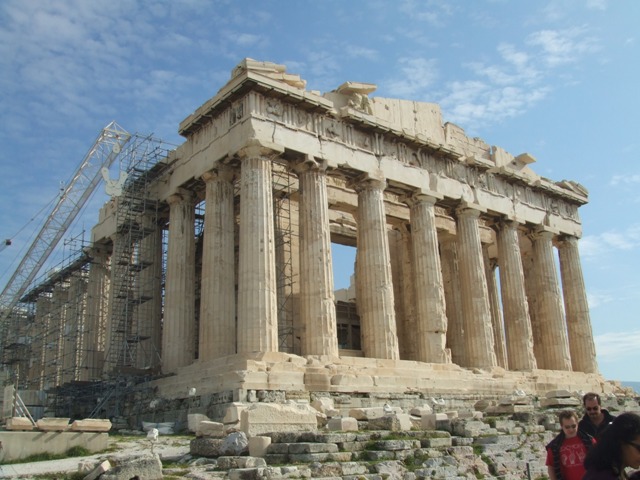
The first reliable historical information about Athens relates to an incident some time after 640BC when a certain Kylon (once an Olympic champion) attempted a coup during a religious festival. The coup failed. He escaped but his followers were
killed. The mythical story of Athens goes back to Theseus who was credited with much of the city-state's legal system and city council. In fact, the region of Attica - unusually large for a city-state - took centuries to unify. More at: Athens
Athens, capital of Greece, was transformed as a tourist destination by the Olympic Games of 2004. The Greek capital now has a modern international airport, metro system and motorway connections to match the unparalleled archaeological sites that have made Athens one of the world's most dramatic cities for thousands of years.
More at: Tourist Athens
Thursday, May 07, 2009
Post-Roman Buildings
What happened to the buildings of Roman Britain? They became a vast quarry for later
medieval builders.
Post-Roman Buildings
medieval builders.
Post-Roman Buildings
Sunday, April 12, 2009
Saturday, April 11, 2009
Lincoln - Historical Accounts
Lincoln (1802 - 1866): Lincoln, a place of considerable note in the ecclesiastical and military annals of England, is singularly situated on the top and side of a high hill, which slopes with a deep descent to the south, where the river Witham runs at its base.
Lincoln - 1
Lincoln - 2
Lincoln - 3
Lincoln - 1
Lincoln - 2
Lincoln - 3
Thursday, December 18, 2008
Vikings Dressed Flamboyantly
Pre-Christian Vikings dressed more flamboyantly than previously thought with the use of vivid colours, silk ribbons, and bits of mirrors. The study identifies men as especially vain, and women as provocative dressers.
Vikings Dressed Flamboyantly
Vikings Dressed Flamboyantly
Tuesday, July 22, 2008
Westward Ho
The price of land in nineteenth century America was a significantly less important factor in Westward Expansion than population growth and technological innovation leading to decreased transportation costs.
Westward Ho
Westward Ho
Wednesday, June 25, 2008
Ancient Canadian Fort Reveals First Nations History
A fortified village pre-dating the arrival of Europeans in Western Canada - the only one of its kind so far discovered on the Canadian plains - is producing intriguing evidence of a hitherto unknown First Nations group settling on the prairies. It is also rekindling ties between the Siksika Nation (Blackfoot) and other groups in the U.S.
Ancient Canadian Fort Reveals First Nations History
Ancient Canadian Fort Reveals First Nations History
Thursday, March 06, 2008
Mayans Used Glittering Pigments On Their Buildings
Ancient Mayans used lustrous pigments to make their buildings glitter in daylight.
Mayans Used Glittering Pigments On Their Buildings
Mayans Used Glittering Pigments On Their Buildings
Subscribe to:
Comments (Atom)